
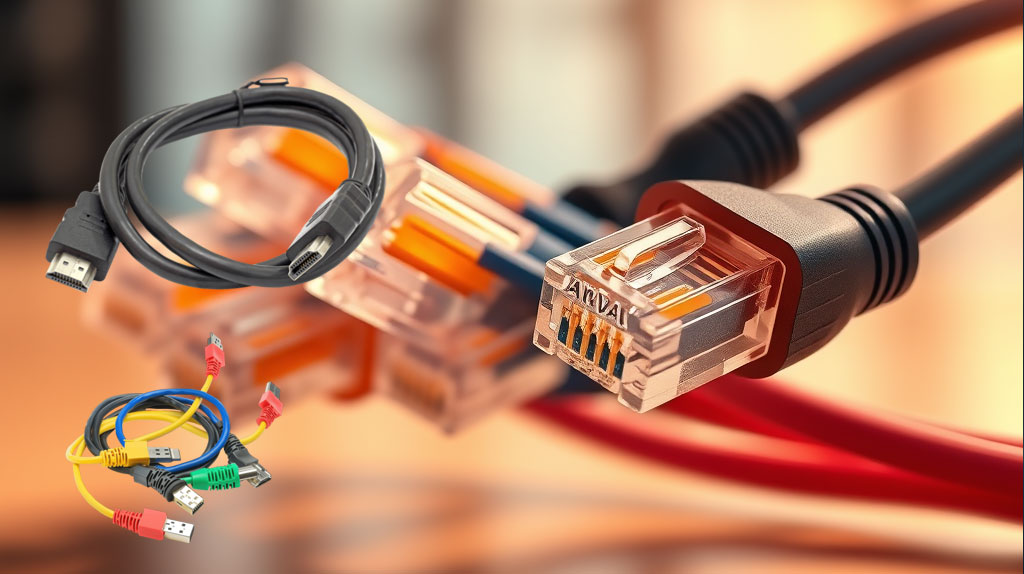
Cat 6 & Cat 5
Cat 6 and Cat 5 (specifically Cat 5e) are Ethernet cable standards used for connecting network devices. Cat 6 is the modern standard, offering higher speeds up to 10 Gbps at 250 MHz and better shielding against interference. Cat 5e handles speeds up to 1 Gbps - (100 MHz) and is better suited for standard, budget-conscious home use.
Cat 5 / Cat 5e (Category 5 Enhanced):
An older, "enhanced" standard for twisted pair cabling, supporting speeds up to 1 Gbps (Gigabit Ethernet) at 100 MHz.
Common for home networks and internet speeds up to 1000 Mbps.
Thinner wires and typically lacks the internal separator (spline) found in Cat 6, making it more flexible.
Cat 6 (Category 6):
A newer, faster standard designed for higher performance networking, supporting speeds up to 10 Gbps (10 - Gigabit Ethernet) at 250 MHz.
Ideal for data centers, high-speed office networks, and future-proofing, effective up to 55 meters for 10 Gbps.
Uses a longitudinal separator (spline) to separate pairs, reducing crosstalk (interference) and providing a thicker, less flexible cable.
3 Pin Coaxial:
"3 Pin Coaxial" usually refers to a Triaxial Cable (often shortened to "Triax"), which is a specialized type of coaxial cable that features an additional, third conductive layer. While standard coaxial cable has a center conductor and one outer shield, a 3-pin/triaxial cable uses two concentric shields separated by insulation, providing superior shielding against electromagnetic interference (EMI).
Function (Guarding):
The inner shield acts as a "guard" to eliminate leakage current, enabling highly accurate, low-level signal measurements, such as in picoamp or femtoamp range.
3-Lug Bayonet (TRB):
They are often terminated with a 3-lug bayonet connector, known as a TRB connector, which looks similar to a BNC connector but is not compatible with them.
Applications:
Commonly used in television production, video, and industrial applications requiring high bandwidth or superior signal integrity.
Industrial/Commercial Use:
They are sometimes used in situations needing extra grounding for safety, such as in certain industrial sensors or specialized camera control units.
HDMI:
HDMI stands for High Definition Multimedia Interface and is the most frequently used HD signal for transferring both high definition audio and video over a single cable.
It is used both in the commercial AV sector and is the most used cable in homes connecting devices such as digital TV, DVD player, and Cctv with the television.
More and more home AV devices are being connected using this simple, effective cable, but now HDMI is also featuring on laptops and PCs and therefore becoming the standard for the corporate and commercial markets – for education, presentation, digital signage and retail display to transmit high quality audio video siganls from device to device.